Choose Filter to select conditions to display recoveries by.
Tracking project information. Click individual routes on the map for more information.
Bibliography
References
Baert, J. M., Stienen, E. W. M., Heylen, B. C., Kavelaars, M. M., Buijs, R. J., Shamoun-Baranes, J., Lens, L., Muller, W.2018
. High-resolution GPS tracking reveals sex differences in migratory behaviour and stopover habitat use in the Lesser Black-backed Gull Larus fuscus. Scientific Reports8
Olsen, K. M., Larsson, H.2004
. Gulls of Europe, Asia and North America. Helm Identification Guides, London
Schmaljohann, H., Liechti, F., Bruderer, B.2008
. First records of lesser black-backed gulls Larus fuscus crossing the Sahara non-stop. J. Avian Biol.39: 233–237
Shamoun-Baranes, J., Burant, J. B., van Loon, E. E., Bouten, W., Camphuysen, C. J.2017
. Short distance migrants travel as far as long distance migrants in lesser black-backed gulls Larus fuscus. J. Avian Biol.48: 49–57
Loading...
Loading...
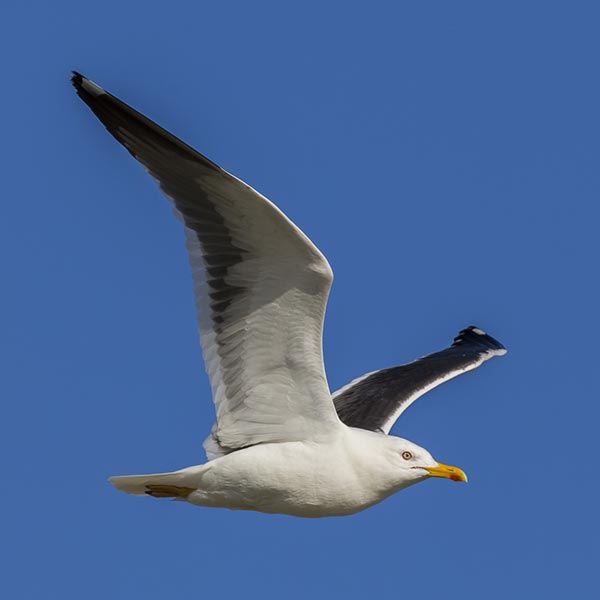
Breeds from W Europe (reaching Iberia), exceptionally Senegambia, to E Fennoscandia (Olsen & Larsson 2004). Strategies vary from resident to long-distance migrants; winter quarters from Europe to W and E Africa, Middle East and along the coast of W North America as well (Olsen & Larsson 2004). Migratory distance can vary even among individual birds from a same colony (Shamoun-Baranes et al. 2017).
Several populations from a migratory perspective: the Atlantic one (assigned to graellsii/intermedius subspecies), which moves along a NE-SW axis, reaching W Africa; the N/E Baltic one (assigned to fuscus subspecies), which uses a NW-SE axis, reaching the Middle East and E Africa (Olsen & Larsson 2004), and the S/W Baltic one, including Germany, Denmark and S Sweden), assigned to intermedius subspecies, which also moves along a main NE-SW axis. The migratory behavior decreases from N to S. Scandinavian birds breeding along the Atlantic winter from C Europe to W Africa, some also remain in S Scandinavia. British birds majorly perform short-range, local movements, though some migrate up to W Africa. In winter, UK hosts birds from N latitudes, from Iceland to Scandinavia. The Finish and Baltic population migrates up to E Africa; some recoveries in winter in Israel. Some N European birds cross the C Mediterranean to reach the Guinea Gulf.
Recoveries by Condition for Lesser Black-backed Gull
Overall, most (90%) recoveries due to birds found alive, identified by other means, such as Darvic leg ring(s). Before 1960, most recoveries were due to shot (35%) or birds found dead, sick or wounded (ca. 50%). Currently, most (95%) recoveries are due to birds encountered alive, mostly identified from leg ring(s). Historically, most encounters have been obtained from 2000 onwards, with a peak around 2010, following a peak in the use of Darvic rings in many projects across much of Europe.
Annual Movements for Lesser Black-backed Gull
Post-breeding movements/migration start as early as late Jun, though the bulk of birds start to move in Jul/Aug. Winter grounds reached from Aug, up to Mar. Migration across Europe majorly coastal; in Africa, both in Apr and Aug/Sep, gulls can cross the W Sahara, ca. 500 km east of the coast and ca. 3,500 m above sea level, assisted by tailwinds, in a non-stop flight from the Mediterranean area to the sub-Saharan winter quarters (Schmaljohann et al. 2008). Return to breeding sites start well before the end of the winter, from Feb onwards. Females reported to stop over for longer and arrive later to their wintering sites (Baert et al. 2018).
Connectivity by Month by Region for Lesser Black-backed Gull
Rather similar between populations; Fennoscandian birds, however, start to move later than their S counterparts (leaving their breeding sites from Jul to Sep). Return to breeding quarters also delayed in Fennoscandian birds as compared to those breeding along the Atlantic; some birds still in Africa in Apr.
Baert, J. M., Stienen, E. W. M., Heylen, B. C., Kavelaars, M. M., Buijs, R. J., Shamoun-Baranes, J., Lens, L., Muller, W.2018
. High-resolution GPS tracking reveals sex differences in migratory behaviour and stopover habitat use in the Lesser Black-backed Gull Larus fuscus. Scientific Reports8
Olsen, K. M., Larsson, H.2004
. Gulls of Europe, Asia and North America. Helm Identification Guides, London
Schmaljohann, H., Liechti, F., Bruderer, B.2008
. First records of lesser black-backed gulls Larus fuscus crossing the Sahara non-stop. J. Avian Biol.39: 233–237
Shamoun-Baranes, J., Burant, J. B., van Loon, E. E., Bouten, W., Camphuysen, C. J.2017
. Short distance migrants travel as far as long distance migrants in lesser black-backed gulls Larus fuscus. J. Avian Biol.48: 49–57