Loading...
Loading...
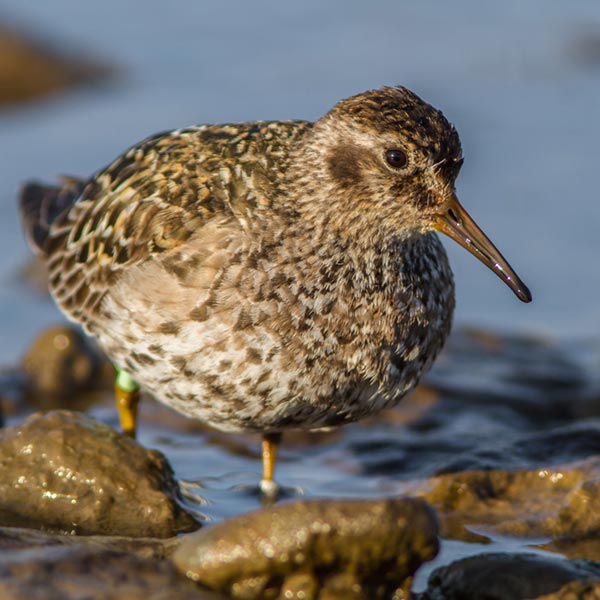
The species breeds in mid- and high Arctic tundra – coastal and upland areas, nesting near fringe of frozen ground. Outside breeding season it mainly occurs on exposed, rocky shorelines often covered with intertidal seaweed, algae and kelp (Payne & Pierce 2020). High-arctic species – its global range extends from the E Canadian Arctic via Greenland and Iceland to Taymyr Peninsula. European strongholds are in Iceland, Scandinavia, Svalbard and Franz Josef Land (Keller et al. 2020).
Intra-European migrant, moving to ice-free coasts in N, NW and W Europe in winter.
Its population trend in Europe is unknown. Evaluated as “Least Concern” (BirdLife Internatinal 2022).
| Season of assessment | W |
| Population trend | Unknown |
| Population size (min-max, best estimate) | 179000-196000,185000 |
| Red List category | LC |
Purple Sandpiper
Scientific Name: Calidris maritima
Thumbnail
Group
Statistics
Map
| N records | N individuals | N recoveries | |
|---|---|---|---|
| Mapped data* | |||
| Total available data | |||
| *Mapped data include only distant (>= 50 km) recoveries |