Choose Filter to select conditions to display recoveries by.
Tracking project information. Click individual routes on the map for more information.
Bibliography
References
Guo-Gang, Z., Dong-Ping, L., Yun-Qiu, H., Hong-Xing, J., Ming, D., Fa-Wen, Q., Jun, L., Tian, M., Li-Xia, X., Zhi, X., Feng-Shan, L.2014
. Migration routes and stopover sites of Pallas’s Gulls Larus ichthyaetus breeding at Qinghai Lake, China, determined by satellite tracking. Korktail30: 104–108
Olsen, K. M., Larsson, H.2004
. Gulls of Europe, Asia and North America. Helm Identification Guides, London
Loading...
Loading...
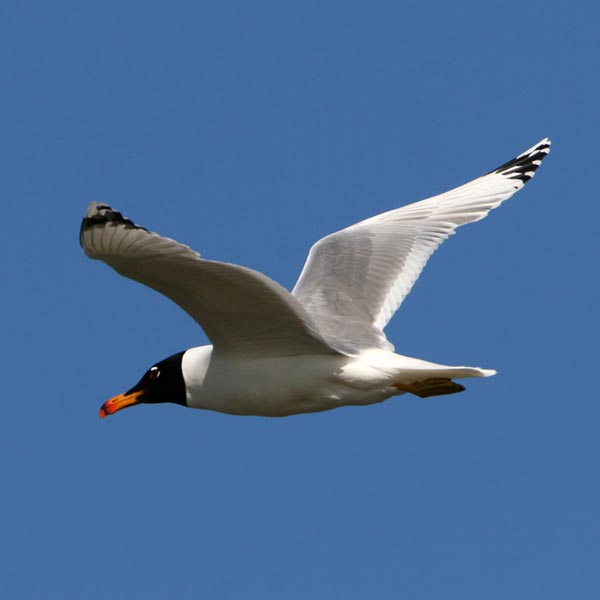
Breeds from the Black sea to Mongolia; winter from the E Mediterranean and the Middle East up to Sri Lanka and Burna (Olsen & Larsson 2004). Migratory; leaves breeding sites soon after young fledge (Olsen & Larsson 2004).
A species scarcely studied, with a few ring-recovery data. Most recoveries come from ringing in a few colonies in Ukraine and Russia (in sites located north of the Caucasus). Relatively short-range movements detected in summer/autumn; recoveries in winter quarters in the Middle East from Oct to Mar, most in Jan-Feb. No recoveries E to the Arabian peninsula (Olsen & Larsson 2004). Wintering quarters in SE Asia (including India) could host birds from very eastern breeding grounds (Guo-Gang et al. 2014), thus located outside Europe, which might suggest parallel migration. Exceptional recovery of a bird ringed in Ukraine in Jun, found dead/sick in Melilla (NW Africa) in Jan.
Recoveries by Condition for Pallas's Gull
Most recoveries due to birds found dead, sick or wounded (ca. 40%) or shot (25%). By regions, it is seen that recoveries in Russia mainly come from birds found dead, sicj or wounded, whilst recoveries from abroad (comprising a minority from the total) come mostly from birds seen alive, identified from leg ring(s) or other marks. This is particularly evident in Israel or countries from E Europe like Ukraine or Poland.
Annual Movements for Pallas's Gull
Soon after breeding birds perform short-range movements, of up to some hundreds of kilometers, concentrating in roosts before the autumn migration (Olsen & Larsson 2004). Recoveries from E Europe from (mostly) Jun to Sep respond to this behavior. Recoveries in winter quarters like Israel mostly in Jan-Feb. Movements to breeding sites start in Feb/Mar.