Choose Filter to select conditions to display recoveries by.
Tracking project information. Click individual routes on the map for more information.
Bibliography
References
Bergman, G.1974
. The spring migration of the Long-tailed Duck and the Common Scoter in western Finland. Ornis Fennica51: 129–145
Karwinkel, T., Pollet, I.L., Vardeh, S., Kruckenberg, H., Glazov, P., Loshchagina, J., Kondratyev, A., Merkel, B., Bellebaum, J. and Quillfeldt, P.2020
. Year-round spatiotemporal distribution pattern of a threatened sea duck species breeding on Kolguev Island, south-eastern Barents Sea. BMC Ecology20: 1–13
Žydelis, R., Dagys, M., Morkūnas, J., Raudonikis, L.2022
. Satellite telemetry of Velvet Scoters, Long-tailed Ducks and Red-throated Divers in Lithuania. LIFE-Nature project "DENOFLIT". www.movebank.org
Loading...
Loading...
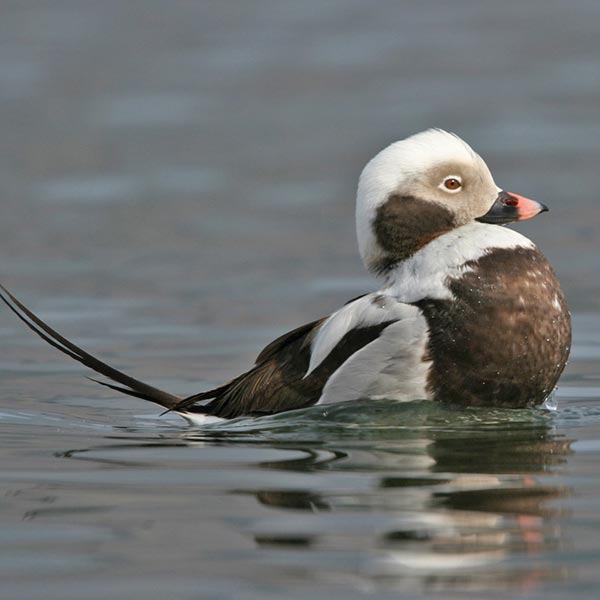
An arctic sea duck with a circumpolar breeding distribution, along arctic coasts of Europe and North America. Winters in cold seas in North and North West Europe, with scarce winterers inland and down to North Mediterranean.
There are few recoveries for this scarce and far-arctic breeding duck, provided mainly by hunting activities. There is one original recovery of a juvenile ringed in W Greenland hunted four years later in Denmark, attesting the wintering of Nearctic populations in Europe. The main arising connectivity is between arctic Russia and the Baltic Sea, especially along southern Finnish coasts (Bergman 1974). There are also some longitudinal movements from Siberia to northern Norway and Iceland. Tracking studies indicate that the Baltic Sea represents the most important wintering area for female long-tailed ducks from Western Russian Arctic, with important spring and autumn staging areas include the Barents Sea and the White Sea (Karwinkel et al. 2020, Žydelis et al. 2022).
Recoveries by Condition for Long-tailed Duck
There are almost only dead recoveries (95%), with ~5% of live recoveries since 1990, while there are almost no recoveries in the 2000s. The species is a game bird in some European countries.
Annual Movements for Long-tailed Duck
Recovery distances indicate some winter movements at a few hundred kilometres, especially from North Europe around. Tracking data (Karwinkel et al. 2020, Žydelis et al. 2022) revealed that western Russian Arctic females moulted at freshwater lakes then went out to sea around breeding sites and to marine waters ranging from the White Sea to Novaya Zemlya Archipelago for a month. After a rapid autumn migration, they spent the winter (7 months) in the Baltic Sea. The spring migration was also rapid, with a stopover of three weeks at sea before returning to the freshwater breeding habitat in June.
Connectivity by Month by Region for Long-tailed Duck
Recoveries on the far north breeding grounds are obtained in May to July, with the first returns to non-breeding grounds in August, though mainly in October, with a presence until February, and movements again for spring migration in April. Arrivals close to breeding grounds are noted from May onwards.
Bergman, G.1974
. The spring migration of the Long-tailed Duck and the Common Scoter in western Finland. Ornis Fennica51: 129–145
Karwinkel, T., Pollet, I.L., Vardeh, S., Kruckenberg, H., Glazov, P., Loshchagina, J., Kondratyev, A., Merkel, B., Bellebaum, J. and Quillfeldt, P.2020
. Year-round spatiotemporal distribution pattern of a threatened sea duck species breeding on Kolguev Island, south-eastern Barents Sea. BMC Ecology20: 1–13
Žydelis, R., Dagys, M., Morkūnas, J., Raudonikis, L.2022
. Satellite telemetry of Velvet Scoters, Long-tailed Ducks and Red-throated Divers in Lithuania. LIFE-Nature project "DENOFLIT". www.movebank.org