En cours de chargement...
En cours de chargement...
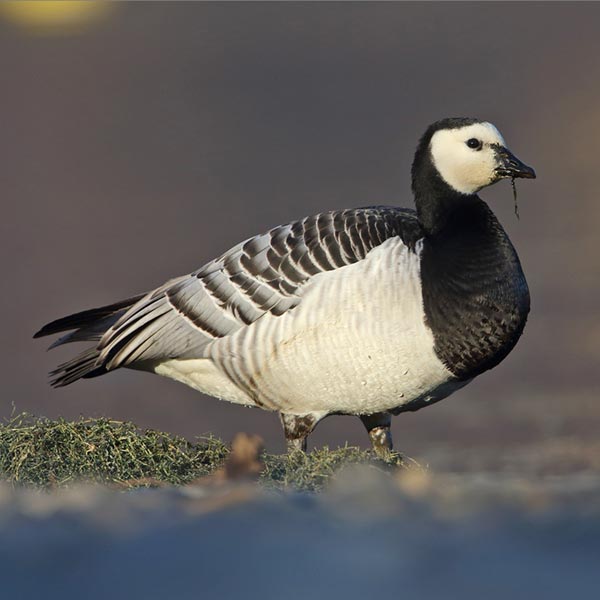
Breeds in three distinct populations in Greenland, Svalbard and Arctic Russia/Baltic/North Sea, wintering in Northern Ireland/Islay, Scotland and the Netherlands respectively. Numbers increased dramatically following protective measures from 1960 to reach well over a million today, still increasing. Used to be strictly arctic-breeding but birds from the Russian population expanded their breeding range to the southwest, with colonies now found throughout the flyway (van der Jeugd et al. 2009). Favours breeding on small islands in vicinity of open grassland areas, but can nest on cliffs, in meadows and even pine forests.
| Season of assessment | W |
| Population trend | Increasing |
| Population size (min-max, best estimate) | 877000-1010000,939000 |
| Red List category | LC |
Bernache nonnette
Scientific Name:
Vignette
Groupe
Statistiques
Carte
| Nombre de données | Nombre d'individus | Nombre de contrôles | |
|---|---|---|---|
| Données cartographiées* | |||
| Données totales disponibles | |||
| *Données cartographiées avec des contrôles >= à 50 km |