Choisir un filtre pour sélectionner les conditions et afficher les contrôles.
Tracking project information. Click individual routes on the map for more information.
Bibliographie
Références
BirdLife International 2021
. Species factsheet: Luscinia luscinia.
Fransson, T., Jakobsson, S., Kullberg, C.2005
. Non-random distribution of ring recoveries from trans-Saharan migrants indicates species-specific stopover areas. Journal of Avian Biology36: 6–11
Hahn, S., Emmenegger, T., Lisovski, S., Amrhein, V., Zehtindjiev, P., Liechti, F.2014
. Variable detours in long-distance migration across ecological barriers and their relation to habitat availability at ground. Ecology and Evolution4: 4150–4160
Stach, R., Jakobsson, S., Kullberg, C., Fransson, T.2012
. Geolocators reveal three consecutive wintering areas in the thrush nightingale. Animal Migration1: 1–7
En cours de chargement...
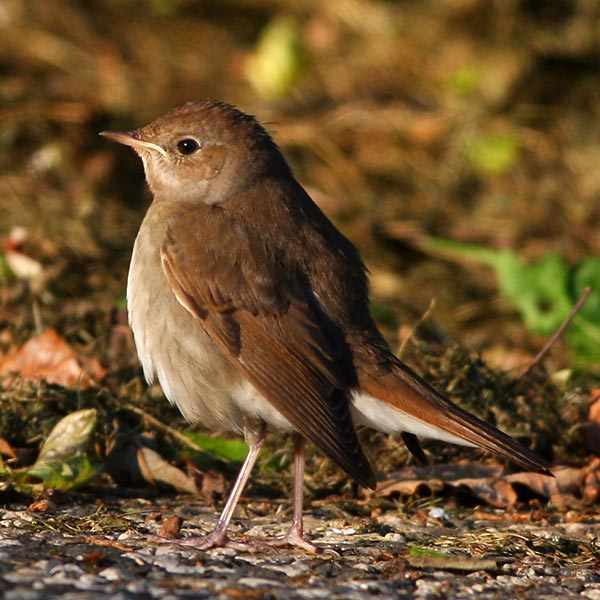
A long-distance migratory passerine; breeds from E Europe to C Asia, overwintering within a relatively small range in E Africa (from Tanzania to South Africa) (BirdLife International 2021).
Few recoveries in E Africa, though the few existing ones fit with the distribution range known for the species (BirdLife International 2021). Migratory axis NW-SE. Only an exceptional recovery of a bird ringed in Denmark, recaptured in Spain. Most recoveries come from ringing carried out around the Baltic region, in S Scandinavia or S Finland. Recoveries N of the Sahara are mostly concentrated in a region N of the Balcans and, then, in the E Mediterranean coasts, mostly in N Egypt, to a lesser extent Israel (see also for details Fransson et al. 2005). Substantial refuel before crossing the Sahara is considered to happen in N Egypt (Fransson et al. 2005). Geolocators reveal three consecutive sites used after the Sahara crossing (Stach et al. 2012), in Sudan, Kenya and, finally, Mozambique. Distance to winter sites can reach up to 10000 km (geolocators show a mean distance of ca. 8500 km for the autumn migration) (Stach et al. 2012).
Contrôles par Condition for Rossignol progné
Most recoveries (90%) due to birds captured alive thanks to ringing. Before 1960, however, almost 30% of recoveries were due to birds found dead/sick/wounded. Since then, most recoveries fit to the general pattern show above.
Annual Movements for Rossignol progné
Ring-recovery data enough to disentangle temporal movement patterns in Europe/N Africa. Breeding quarters left by Aug. Passage in N Africa mostly in Sep. First recoveries S of the Sahara are found in Nov. Geolocators confirm these results, though provide more details for the period in which the birds are in Africa. Presence in Africa S of the Sahara from Sep to Mar [BMAREF303]. Passage in spring in Europe patent in Apr. Arrival to breeding quarters in May.
Connectivité par mois par région pour Rossignol progné
In autumn, concentrations N of Balcans in Aug-Sep, which could indicate some refueling. Then, main stopovers in SE Europe/NE Africa from late Aug to Sep. Geolocators reveal that first wintering sites in Sudan from Sep to Nov; then second winter quarters in Kenya in Nov-Dec, and then the last wintering area further S in Dec-Mar (Stach et al. 2012). Recoveries in spring suggest a further E passage than in autumn within the Mediterranean, with a higher proportion of recoveries in Israel as compared to Egypt. Such variations are normally due to the fact that birds tend to pass over those areas providing more suitable habitats to forage (e.g., Hahn et al. 2014).
BirdLife International 2021
. Species factsheet: Luscinia luscinia.
Fransson, T., Jakobsson, S., Kullberg, C.2005
. Non-random distribution of ring recoveries from trans-Saharan migrants indicates species-specific stopover areas. Journal of Avian Biology36: 6–11
Hahn, S., Emmenegger, T., Lisovski, S., Amrhein, V., Zehtindjiev, P., Liechti, F.2014
. Variable detours in long-distance migration across ecological barriers and their relation to habitat availability at ground. Ecology and Evolution4: 4150–4160
Stach, R., Jakobsson, S., Kullberg, C., Fransson, T.2012
. Geolocators reveal three consecutive wintering areas in the thrush nightingale. Animal Migration1: 1–7