Choisir un filtre pour sélectionner les conditions et afficher les contrôles.
Tracking project information. Click individual routes on the map for more information.
Bibliographie
Références
BirdLife International 2022
. Species factsheet: Pinicola enucleator.
Peter Clement2010
. Finches and Sparrows. Helm Identification Guides. ISBN: 1408135302, 9781408135303A & C Black, London 512pp
En cours de chargement...
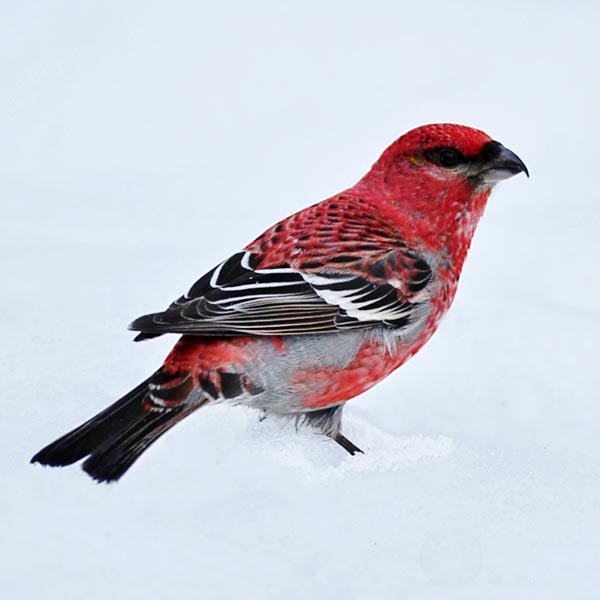
Species with a very large range, in Europe (representing a quarter of its global breeding area), occurs in boreal woodland from subarctic Fennoscandia to Russia (BirdLife International 2022). Mainly sedentary or partially migratory with erratic or irruptive movements to S of breeding ranges (Clement 2010).
Limited amount of ring-recovery data in Europe. Most available mapped data from N European ringing regions, only a few from E Europe. Most recoveries show movements within Finland. Few individuals move from Finland to S half of Norway and Sweden. An individual ringed in N Russia recovered in S Finland. Number of encounters through time shows some outstanding years in number of captures, showing probably irruptive migration years (recently 2012 and 2018).
Contrôles par Condition for Durbec des sapins
Overall, most recoveries (88%) are due to birds seen alive, identified by ringing activities. The proportion of dead recoveries, overall, represent 10%, and are due to birds found dead (other than shot), sick or wouinded. The recovery condition category distribution had a great change over time. Before 1960, there were no recoveries of birds seen alive. In 1961-1990 ringing recoveries already represented 77%, and from 1991 to present these recoveries reach up to 90% of the total.
Annual Movements for Durbec des sapins
Pine Grosbeak has a sedentary or partially migratory life strategy. Depending on the year, just a few birds leave breeding ranges, while in other years whole populations may move hundreds of km (95% of recorded distances <750 km), caused by food shortage. Departure from breeding quarters late Sep-Oct, and return to breeding sites from late Feb to Mar (Clement 2010).No mapped data available from Jul to Sep.
Connectivité par mois par région pour Durbec des sapins