En cours de chargement...
En cours de chargement...
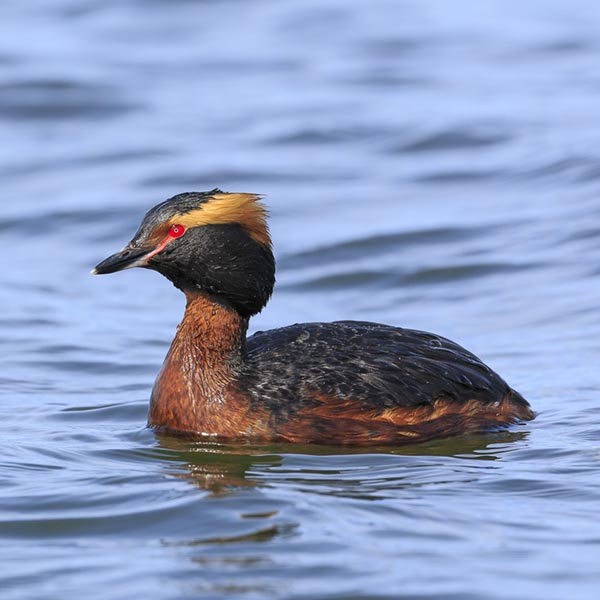
The species breeds on fresh or brackish waters occupying small natural and shallow wetlands with abundant vegetation. During migration and winter occurs mostly on marine (coastal) waters, usually less than 10-20m in depth. It has circumpolar distribution – the breeding range covers most of N & NW Europe, the taiga belt E to Kamchatka, N & NW North America (Stedman 2020). The abundance hotspots in Europe are N Iceland, E Sweden, SW Finland and Russia (Keller et al. 2020).
Intra-European migrant. Outside breeding season moves further S or to nearby seas.
Its population trend in Europe is decreasing. Evaluated as “Vulnerable” (BirdLife International 2021).
| Season of assessment | B |
| Population trend | Decreasing |
| Population size (min-max, best estimate) | 14200-19200,16100 |
| Red List category | NT |
Grèbe esclavon
Scientific Name:
Vignette
Groupe
Statistiques
Carte
| Nombre de données | Nombre d'individus | Nombre de contrôles | |
|---|---|---|---|
| Données cartographiées* | |||
| Données totales disponibles | |||
| *Données cartographiées avec des contrôles >= à 50 km |